

Say you deposit $100 right into a savings account that pays compound interest at a rate of 5%. After one yr, you’ll have earned $5 in curiosity on your unique investment, putting $105 in your account. Compound curiosity on some types of investments, corresponding to financial savings accounts or bonds, is taken into account income. There is usually a big distinction in the amount of interest payable on a mortgage if curiosity is calculated on a compound foundation rather than on a easy basis. But the magic of compounding can work to your benefit when it comes to your investments.
- Some loans also use easy interest, including private loans, scholar loans and auto loans.
- If you may have a quick lived mortgage or one with curiosity that doesn’t compound, you’ll solely have to worry about interest added onto the outstanding principal balance.
- Understand the distinction between Simple and Compound Interest, their formulation, real-world use circumstances, and the way to calculate them simply utilizing our free SI-CI Calculator.
- Let’s learn how to calculate compound curiosity as repeated simple interest.
- The extra typically your curiosity compounds, the more interest you’ll earn on your funding.
Simple curiosity is computed annually on the principal balance firstly of the period, whereas compound interest may be accrued at any time interval. Curiosity is the sum of money you must pay to borrow cash in addition to the loan’s principal. It Is additionally the quantity you’re paid over time when you deposit cash in a financial savings account or certificates of deposit. You are essentially loaning cash to the financial institution, and it’s paying you interest. Different savings and funding accounts use various interest mechanisms. Understanding how curiosity compounds (daily, monthly, or annually) lets you select products that maximise returns or minimise prices.
This method, you probably can make sure that your money still could have purchasing power in the future. Your initial funding (PV) of $10,000 is shown with a negative sign, in accordance with the cash move conference, because it represents an outflow of funds. PV and FV should essentially have reverse signs to resolve “i” within the above equation. The force of interest is lower than the annual efficient interest rate, but more than the annual efficient discount price. For loans, simple interest is predicated on only the principal amount, whereas compound curiosity relies on the principal and curiosity combined. Not Like easy interest, compound interest entails earning curiosity on curiosity.
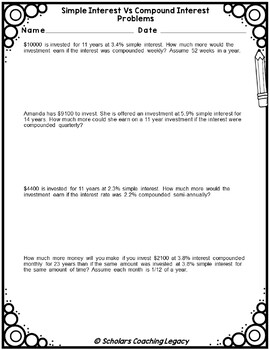
Simple interest is normally owed on traditional mortgages, automobile loans, and personal loans. Receiving simple curiosity as an investor is comparatively rare, though investing in bonds entitles you to earn simple interest as long as you personal the safety. Easy curiosity works in your favor whenever you borrow cash, whereas compound curiosity is better for you as an investor. As a borrower, easy curiosity is best because you’re not paying interest on curiosity. Compound interest can help you to build wealth over time because your earnings additionally earn cash.
Related Content Material
Beyond simply numbers, interest rates inform financial futures, shaping how wealth accumulates over time. As we explore the variations between easy https://www.simple-accounting.org/ and compound interest, we goal to empower you to make informed monetary decisions. A savings account grows extra shortly by earning compound interest than easy interest.
You multiply the principal ($5,000) by the annual rate of interest (3% or zero.03) by the months the CD was energetic (4 out of 12 months). How much will the student pay again in whole, together with the principal and all curiosity payments? Add the principal quantity ($18,000) plus simple curiosity ($3,240) to find this. The scholar will repay $21,240 in total to borrow money for school. Here is every little thing you have to know about easy and compound interest for GCSE maths (Edexcel, AQA and OCR).
Compound Vs Simple Curiosity: What Is The Difference In Your Investments?
The main difference between easy and compound interest involves the benefits and disadvantages when the interest rate applies to a loan or to a financial savings or funding product. Simple interest means there is not any “interest on curiosity.” With a loan, a borrower wouldn’t pay interest on accrued interest. With financial savings or investments, an account holder wouldn’t earn interest on accrued curiosity.
If a savings or funding account compounds the interest, someone earns interest on the principal in addition to the amassed interest. However if a financial savings or funding account offers easy interest, someone earns curiosity only on the principal and never the accrued interest. With compound curiosity, your earnings develop primarily based on your unique investment and curiosity earned.

Every knowledgeable choice contributes to a safer and prosperous outlook. Alternatively, Bankrate’s compound curiosity calculator can come in handy in determining how much you’ll find a way to earn when you enter info such as a greenback amount, APY and time frame. Suppose you take out a $10,000 personal mortgage with a simple rate of interest of 5% per yr for three years. Suppose you want to begin a business after school by making a cool new app. To fund all the prices involved, you borrow $500,000 for 3 years from a wealthy aunt, paying 5% easy interest. You plan to repay the loan in three years in a single lump sum, with income you make after someone buys your corporation.
Time Value
Avoid owing compound interest on debt in favor of debts with easy curiosity such as mortgages. Prioritize investments like shares that allow your gains to compound over time. Simple curiosity products like bonds offer stability, whereas compound interest merchandise like mutual funds or financial savings accounts provide higher development potential. Make positive you know the precise annual share rate (APR) in your mortgage because the tactic of calculation and number of compounding durations can have an impact on your monthly payments. In general, compound curiosity will yield higher returns than easy curiosity when utilized over longer periods.
We’ll dive into the necessities of simple vs. compound curiosity together with definitions, account sorts, and real-world functions to optimize your monetary technique and assist you to develop wealth. The compound annual progress rate (CAGR) is used for many monetary purposes that require the calculation of a single development price over a interval. Cash is not “free” but has a value by means of curiosity payable, so it follows that a dollar at present is value greater than a dollar sooner or later.